
Performative safe space participation aesthetics
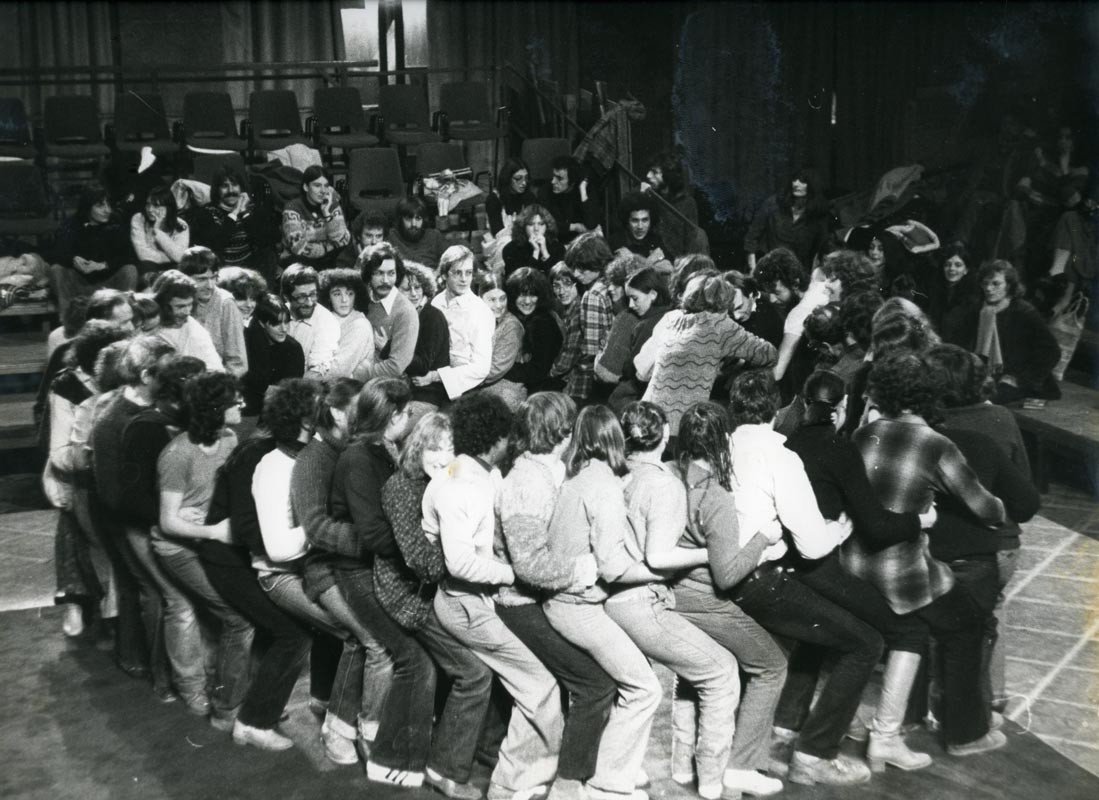
Workshop-Theater of the Oppressed in Paris (1975)
Social life unfolds as a performance. Values are publicly expressed and identities are curated, just like the vintage stores around the corner. What once was considered low-class second hand, is now a status symbol of the ethically superior. Recycling the past has become fashionable because it is simpler than imagining a future. The question is no longer simply what we believe, but how convincingly we enact belief. Caring is no longer enough, one must demonstrate it, curating evidence of performance along the way. Under these conditions, authenticity becomes the new genre, one more aesthetic to perfect. We all know this is absurd, but we play along, staying in the cycle of cynical compliance.
Safe spaces show how ethics can become aesthetic. Originally, they were meant as places where vulnerable people could speak without fear of humiliation. Over time, the concept expanded: safety began to involve emotional protection and even discomfort could be seen as harm. To signal commitment to safety is to signal moral sophistication. Institutions advertise safe spaces as signs of progressiveness, individuals use them to demonstrate care. The more safety becomes a public measure of character, the more it risks becoming symbolic. Moral life narrows into a binary: protector or perpetrator, ally or oppressor. This doesn’t deny real harm or the need for inclusive spaces. But it raises the question whether elevating safe spaces end up limiting debate.
In a world where everything is becoming increasingly performative, one might wonder: how do we move away from symbolic gestures without falling into cynicism? How do we de-performatize ourselves?
David Rieff calls wokeness the lingua franca or ‘bridge language’ which sets the terms of cultural intelligibility. A language that everyone is forced to speak in relation to. Its moral grammar sets the boundaries of acceptable discourse: healing, authenticity, trauma, emotional labour, identity, inclusivity, trigger warnings and safe spaces. These therapeutic values govern individual behavior.
“We now live in a culture in which not to consider yourself a victim is a pathology…or else, whether you realize it or not, or are willing to admit it or not, it is to be an oppressor.”
The logic is simple: if you don’t claim victimhood, the culture may assume that you are part of the problem.
In Western society, psychological well-being becomes the supreme authority. If this is true and wokeness is the new religion and trauma its god, then we have to create an anti-healing ritual and keep our wounds open to avoid being the oppressor. Aka only an endless healing cycle can save you from being a sinner. In the same manner, suffering has turned into a cultural capital, a marketable identity.
In postmodern society, knowledge based on revelation is replaced by scientific knowledge grounded in proof. This proof is no longer validated by truth or emancipation but performativity. As a result, science becomes integrated into the circulation of capital: ‘no technology without wealth, no wealth without technology’ as Lyotard states. Consequently, no money, no proof. Research is funded according to its capacity to enhance the system’s performance. Power now depends on data storage and access, the more information you have about reality, the more authoritative your statements become. So no money means no technology, leading to no proof and no truth.
But what is the root of performativity and what does trauma language point to?
The ecology of the mind is governed by symbolic gestures and the desire to be (un)seen in online and public spaces. Creating the self as one might say. The sacred, the myths and clear moral prohibitions ceased to exist and the expressive individual became the central element of culture. The distinction between the stage and audience, personal and private, online and offline spaces have been dissolved. In this postmodern context, the collective unconscious has lost its function, each individual has been liberated, decolonized and rebuilt from its intrinsic identity and values. Subjectivity has become the new objectivity, where the feelings of individuals about gender, identity and trauma define their social reality. In this reality, disagreement becomes a moral violation. The ecology of the mind is driven by the constant need to seek healing, emotional comfort and recognition. This manifests in self-help rituals, wellness culture, self appointed life coaches and slacktivism. While healthcare is being defunded, privatised and self-help romanticized, the artist is becoming the new social worker. Powered by the legacy of Freud and his friends, art therapy and neighborhood projects are becoming the new norm, offering temporary relief and community.
In the ecology of the socius, everyone is forced to participate through constant surveillance. Through the exposure of private and public spaces, society itself has become performative, each individual performing to their own accounts. Performance culture refers to a society where people, institutions, and even emotions are constantly measured. It is not just about working hard, it is about always having to prove that you’re doing well. Performance culture does not require an external supervisor. Through optimizing leisure and constant self-monitoring, the system’s regulation becomes internal. Unlike in repressive regimes, where no self-healing is even possible, in the capitalist reality people are caught in an endless therapy loop.
This performative society is governed by therapeutic values and cancel-culture. Participation is deeply embedded in this performative turn. Participatory art is not something new, but it is tied to the historical avant-garde. The legacy of the 1960s-70s, its happenings, performance- and community arts, have challenged the artwork as object and focused on the process, collaboration and experience. These were intended to be micro-political ways to create change and were often tied to oppressive regimes. For instance, the Brazilian theatre maker, Augusto Boal, developed the Theatre of the Oppressed in the 1970s of Argentina in the context of the brutal military rule beginning in the mid-1960s. This method involved staging performances in public spaces with audiences who unknowingly became participants, confronting issues as class inequality and repression.
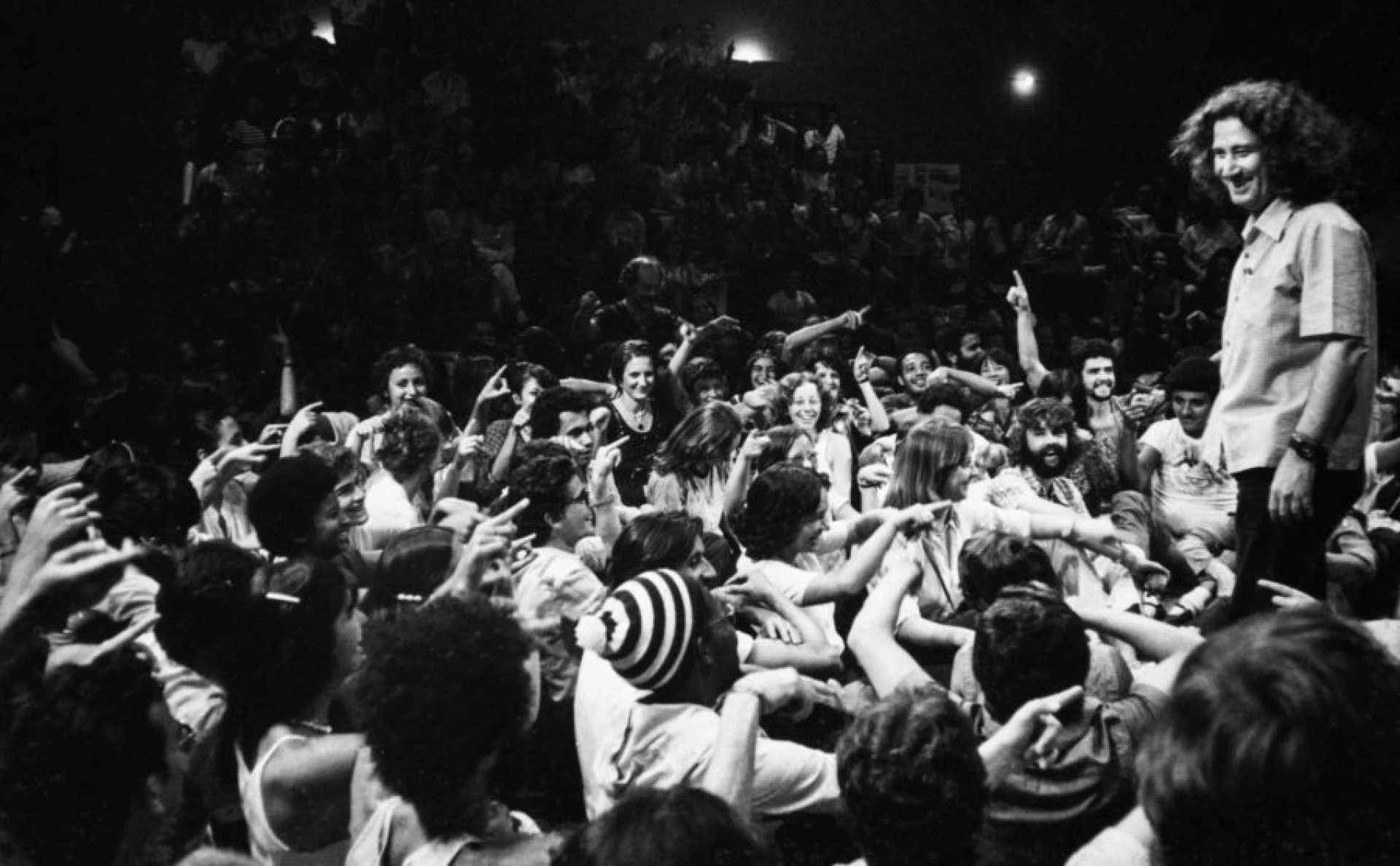
Workshop - Theater of the Oppressed in Paris (1975)
Experiencias ‘68 was another experimental exhibition opening up the art institution to participation and political critique under the repressive regime. It also included a work from Oscar Bony, La Familia Obrera (Blue-Collar Family), which was an installation consisting of an actual working-class family seated on a pedestal. The authorities censored the controversial work which resulted in artists publicly destroying their works and a declaration against censorship. In these events, participatory art did not just symbolically engage the public but triggered real political conflict and censorship. The experimental theater of the 1960s and 70s was tied to large political ideologies and a loss of trust in institutions. In contrast, today's woke culture increasingly functions as a form of moral theater performed in online and public spaces, preoccupied with deplatforming individuals.
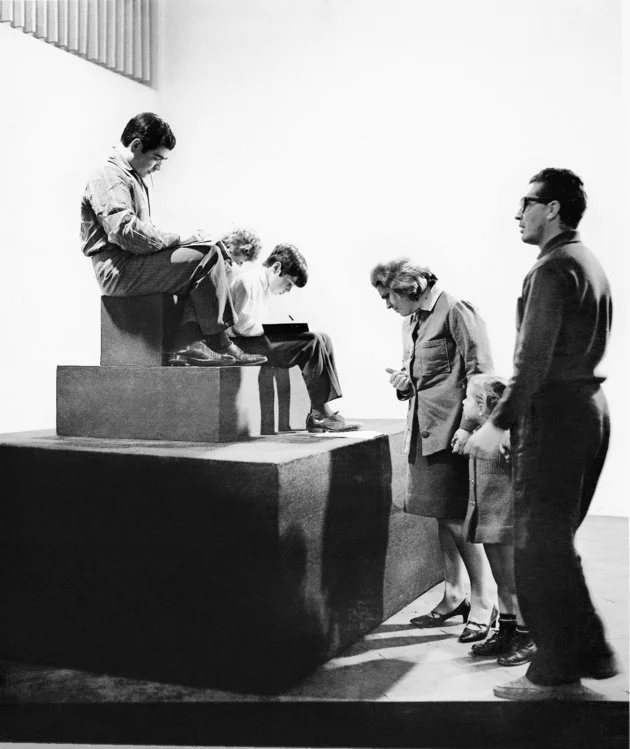
Experiencias ‘68 - Oscar Bony, La Familia Obrera
Cultural institutions are shifting towards the narrative of participation, implying it on art projects from a topdown approach. Claire Bishop argues whether this participation empowers the participants or simply serves the interests of the artist and the institution. This moral turn in art judges artworks based on their ethical or social intentions over aesthetics or their critical quality. At the same time, artists and curators of the woke canon risk reducing art to illustration of the ‘ethical’. Gestures become symbolic, educational and conformist and words lose their meaning. So one might argue that being cancelled will become the anti-institutional neo avant garde.
Looking through the lens of the ecology of the environment, Guattari describes it as polluted and overloaded. This is in parallel with the exhaustion or complete disregard of aesthetics (see Bourriaud) and art’s reduction to institutional compliance. He argues that this crisis stems from capitalist rationality and commodification. The ‘woke canon’ emerges within the same neoliberal institutional environment: museums operating as corporations, diversity and trauma becoming their assets while political content becomes a marketable product. Today’s art is not only culturally woke but it is environmentally conditioned by neoliberalist infrastructures. This points to a broader crisis of ethical and political legitimacy, driven by skepticism toward meta-narratives, whether religious, political or otherwise. Guattari’s ecosophy calls for heterogeneity and experimentation, so I couldn’t help but wonder: have we taken the wrong turn since 1989?
Welcome to the post-woke, post-participatory, post-traumatic, post-print era <3
-Teodóra Róka
countercynic
